What is MCP?
The Model Context Protocol (MCP) is an open standard designed to enable intelligent AI applications to seamlessly communicate and interoperate with a wide range of external tools and services. MCP abstracts away integration complexities by defining a unified, extensible communication layer that supports context-aware interactions.
https://modelcontextprotocol.io/
Overview of MCP
Architecture
MCP is structured around a modular client-server architecture consisting of three primary components:
-
Server: The service or knowledge provider, which exposes functionality or data to external clients.
-
Client: Acts as a communication endpoint, maintaining a 1:1 connection with a specific Server instance. Clients manage the request/response lifecycle and facilitate context exchange.
-
Host: The host manages one or more clients, and provides the MCP-enabled services to the intelligent application
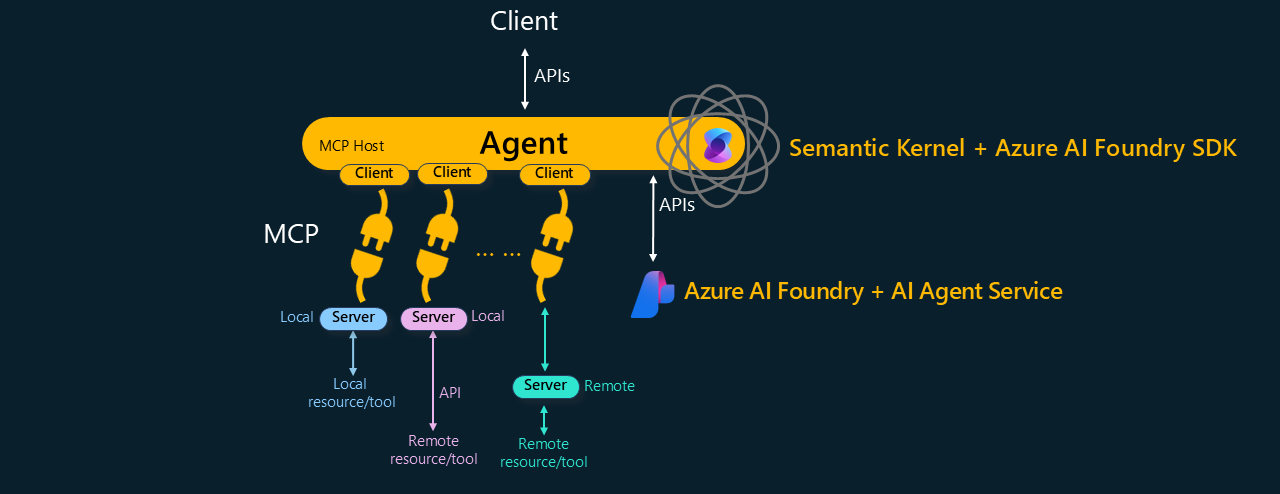
This design separates concerns cleanly:
-
Resource owners manage Server implementations, controlling service logic and data.
-
Application developers integrate MCP clients into their hosts, enabling plug-and-play extensibility without needing to know about the service internals.
Transport protocols
MCP supports two primary transport mechanisms:
-
Standard In/Out: Designed for local services running on the same machine, leveraging standard input/output streams.
-
HTTP (Streamable): Facilitates remote communication over the web.
Note some documentation refers to SSE (Server-Sent Events) - this has recently been deprecated in favor of standard HTTP streaming.
MCP Ecosystem
The MCP ecosystem is expanding rapidly, with hundreds of compliant services available. Integrating these services into intelligent applications requires minimal configuration.
Catalogs of MCP compliant tools include: